
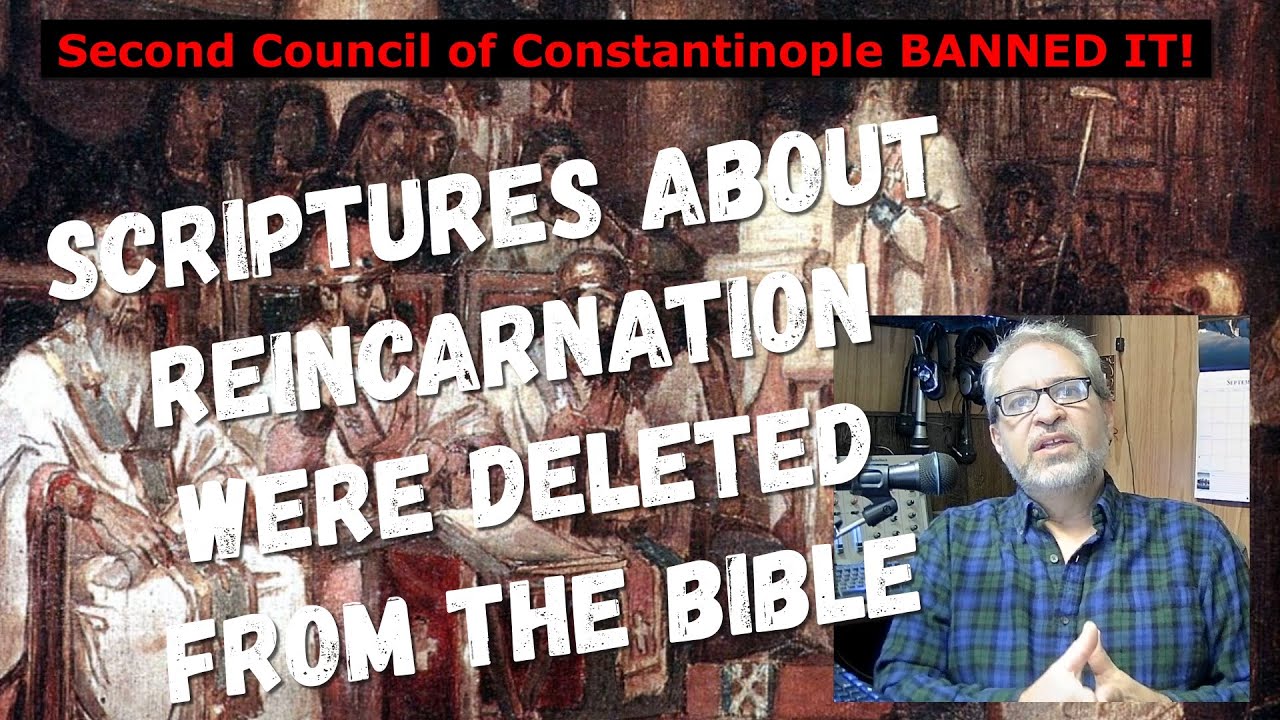
In this video we will discuss when, how, and why scriptures in the New Testament of the Bible about reincarnation were removed or left out of the canonized (finalized) Bible. Writings that would have been used if not banned by the Church and powerful rulers. We will talk about the people responsible for banning those scriptures, specifically the Christian Church, Emperor Justinian, and the Second Council of Constantinople (553 A.D.), and their reasons for doing so. We will discuss how Pope Vigilius, during that time, was opposed the changes, but relented under pressure from Justinian and eventually signed the decree banning teachings of reincarnation, specifically the writings of an early Christian scholar, Origen of Alexandria, who wrote about reincarnation more than 300 years prior to The Second Council of Constantinople (a place known today as Istanbul).
source













There is no proof guys come on
I have come to conclude after many years of study that Paul was a Roman Herodian imposter giving Christians pro-Roman mandatory duties to obey Roman rulers (ROmans 13); for married men to behave as having no wife, i.e., be celibrate (1 Cor. 7); for unmarried men and woman to not get married either because it causes wordliness — the desire to please one's spouse (1 Cor. 7) and many more examples.
Paul's Herodian family (Acts 13:1; Romans 16:14) resented "messianc" Jews who did not acknowledge him as king. Thus Christians were a special target and thus perverting their knowledge of God, and instilling them with hellenism, paganism, and eating meat sacrificed to idols; not keeping sabbath; etc — all were policies Paul taught to suit his Roman Herodian family.
Sab sanatani hai
✦ Seth as the Appointed Vessel: A Divine Continuation of Abel’s Legacy ✦
Genesis 4:25 (KJV):
“And Adam knew his wife again; and she bare a son, and called his name Seth: For God, said she, hath appointed me another seed instead of Abel, whom Cain slew.”
This verse does not call Seth merely another child—it declares him a divinely appointed replacement for Abel, signaling purposeful substitution, not mere succession.
⸻
1. “Instead of” (Hebrew tachat)
The Hebrew word tachat means “in place of” or “substitute,” not simply “after.” It implies something lost has been actively replaced. Eve’s words show she recognizes that God has restored what was taken, not just given her another son.
Seth’s appointment follows immediately after the Bible’s very first death—Abel’s murder by Cain—revealing God’s swift and purposeful intervention. This subtle pattern sets a divine precedent: when a vessel is destroyed, God appoints a new one to continue His purpose.
⸻
2. “Seed” (zera) as a Vessel
The word zera (translated seed) often means offspring, but its literal sense is that which is sown—like a seed planted into the earth.
Theologically:
• The body is a temporary vessel, a “seed” housing the soul.
• The soul or spirit enters that vessel, animating it and expressing divine purpose.
• When the body dies, it returns to dust, but the spirit returns to God.
Ecclesiastes 12:7 (KJV):
“Then shall the dust return to the earth as it was: and the spirit shall return unto God who gave it.”
Cain destroyed Abel’s body—the seed—but could not destroy his soul. God appointed Seth as a new seed, a fresh vessel through which Abel’s righteous purpose could continue.
⸻
3. The Soul’s Continuity
As Ecclesiastes 12:7 affirms, while Abel’s body was destroyed, his spirit was not lost—it returned to God. The soul is not bound to a single body. If God so wills, He could reassign that spirit—or the mission it carried—into a new vessel.
Hebrews 9:27 (KJV):
“It is appointed unto men once to die, but after this the judgment.”
This verse shows that each human life experiences one death and judgment. If God appoints a soul to a new vessel, that life also is singular and unique. This allows for spiritual continuity across vessels without contradicting Scripture, supporting the idea that Seth could carry Abel’s spirit or divine mission.
⸻
4. The Temporary Tent
2 Corinthians 5:1–4 (KJV):
“For we know that if our earthly house of this tabernacle were dissolved, we have a building of God, an house not made with hands, eternal in the heavens… For we that are in this tabernacle do groan, being burdened: not for that we would be unclothed, but clothed upon, that mortality might be swallowed up of life.”
Paul calls our body a temporary tent—a fragile, earthly vessel we long to be clothed anew with an eternal one. Abel’s tent was destroyed, but his spirit endured. God appointed Seth as a new tent, a fresh container for the divine mission—a restoration, not a restart.
⸻
5. Scripture’s Precise Language
If Seth were merely another son, Scripture might say, “God gave me another child.” Instead, it says:
“God hath appointed me another seed instead of Abel.”
This signals a deliberate continuity, not mere succession. Seth is a restored vessel, not a new beginning. The wording is purposeful and precise.
⸻
6. Seth’s Righteous Line
Genesis 4:26 (KJV):
“And to Seth, to him also there was born a son; and he called his name Enos: then began men to call upon the name of the Lord.”
Seth’s line marks a spiritual revival, in contrast to Cain’s rebellious lineage (Genesis 4:17–24). This line leads to Noah, Abraham, and ultimately Christ. The righteous intent Abel held reemerges in Seth’s descendants.
⸻
✦ In Summary ✦
God did not merely give Eve another child—He appointed Seth to carry Abel’s righteous purpose. Cain succeeded in killing Abel’s body but not the divine plan Abel represented.
• Seth was a replacement seed—a new tent for a living purpose.
• The soul endures beyond the body, and God, sovereign over creation, appoints vessels as He wills.
• Righteousness was not extinguished—it was restored.
• Seth’s role is theologically profound, not merely genealogical.
This interpretation weaves together Genesis, Ecclesiastes, Hebrews, and 2 Corinthians into a portrait of a God who restores what is torn down, preserves spiritual purpose, and replants divine mission through appointed vessels.
Classic Definition of Reincarnation
A soul, after bodily death, is reborn into a new body, continuing life without past-life memories and unrecognized by others.
1.Elijah Has Come — And Is Coming Again
Jesus drops a bombshell:
“Elijah indeed is coming first and will restore all things. But I tell you that Elijah has already come, and they did not recognize him but did to him whatever they wished.”
— Matthew 17:11–12 (modified from ESV)
Three explosive claims here:
• Elijah is coming (future tense).
• Elijah has already come (past tense).
• And Critically: nobody recognized him.
Not the religious leaders, the people of Israel, the public, John the Baptist himself, or even the disciples and possibly Zechariah himself, until Jesus spelled it out.
John was clear about his own identity:
“They asked him, ‘Are you Elijah?’ He said, ‘I am not.’”
— John 1:21 (NKJV)
But Jesus clarified:
“Then the disciples understood that He was speaking to them of John the Baptist.”
— Matthew 17:13 (NKJV)
Breakdown:
• John denied being Elijah (John 1:21).
• The disciples were clueless—until Jesus explained.
Jesus overrides:
• John’s denial.
• The disciples’ confusion.
If John was right and Jesus was wrong, we’ve got a problem. But that’s not an option. Jesus’ word is final.
Some say Elijah was taken to heaven bodily and never died, but Scripture states “flesh and blood cannot inherit the kingdom of God” (1 Corinthians 15:50). Jesus also said, “No man hath ascended up to heaven but he that came down from heaven” (John 3:13), showing Elijah did not enter God’s eternal presence in flesh. His translation was miraculous but not glorification or exemption from physical death.
⸻
2. Gabriel’s Partial Truth, Jesus’ Full Revelation
The angel Gabriel said John would come “in the spirit and power of Elijah” (Luke 1:17, NKJV). But this is only part of the story.
Gabriel’s words describe John’s role—his prophetic mission mirroring Elijah’s. As an angel, Gabriel delivers divine truth, but it’s tailored to the Jewish expectation of a forerunner, not the full reality of Elijah’s return.
Jesus, as God incarnate, reveals the deeper truth:
“And if you are willing to accept it, he is Elijah who is to come.”
— Matthew 11:14 (NKJV)
Jesus doesn’t say “like Elijah” or “in the role of Elijah.” He says John is Elijah—the same prophet promised in Malachi 4:5:
“Behold, I will send you Elijah the prophet before the coming of the great and dreadful day of the LORD.”
— Malachi 4:5 (NKJV)
This isn’t symbolism. It’s identification. Jesus confirms Elijah’s soul inhabits John’s body, fulfilling the prophecy literally, even if John himself didn’t know it (John 1:21).
The “spirit and power” language connects to Elisha’s request for a “double portion of your spirit” (2 Kings 2:9, ESV). This isn’t Elijah’s soul but his prophetic authority, like the firstborn’s inheritance in Deuteronomy 21:17. The sons of the prophets confirm: “The spirit of Elijah rests on Elisha” (2 Kings 2:15). Similarly, Luke 1:17 describes John’s inherited mission, not Elijah’s soul. Jesus’ “he is Elijah” reveals the bombshell: Elijah’s soul resides in John’s body.
To call this symbolic undercuts Malachi’s promise and Jesus’ authority. If God says He’ll send Elijah, and Jesus says Elijah came as John, the prophecy is fulfilled—not reimagined.
⸻
3. Jesus Raises the Question About Returning Souls
Jesus asks:
“Who do people say that I the Son of Man am?”
— Matthew 16:13 (NIV)
The disciples answer:
“Some say John the Baptist; others say Elijah; and still others, Jeremiah or one of the prophets.”
— Matthew 16:14 (NIV)
Why let this talk of soul return—Jesus as Elijah, Jeremiah, or another prophet—go uncorrected? The crowd’s speculation shows a widespread belief in souls returning in new bodies, not just resurrection. Jeremiah’s been dead for centuries; this isn’t about rising from the grave but returning in a new life.
Jesus doesn’t shut it down. Instead, He confirms a case of soul return in Matthew 11:14, calling John Elijah.
This leaves the door wide open for reincarnation as a real possibility. If it were false, Jesus would’ve corrected it, as He did with other errors (e.g., Mark 7:6–13). His silence, paired with His affirmation of Elijah’s soul in John’s body, speaks volumes.
⸻
4. Why Was Jesus Silent? Because It’s Scriptural
Reincarnation fits the Bible’s framework:
• Elijah’s Prophesied Return: “I will send you Elijah the prophet” (Malachi 4:5, NKJV). Jesus confirms this happened with Elijah’s soul in John’s body (Matthew 11:14).
• Moses and Elijah at the Transfiguration: “Moses and Elijah appeared, talking with him” (Matthew 17:3, NIV). Souls can manifest post-death.
• Samuel’s Appearance: “Samuel said to Saul, ‘Why have you disturbed me by bringing me up?’” (1 Samuel 28:15, NIV). A dead prophet interacts physically.
• Saints Raised at the Crucifixion: “The tombs broke open… and many bodies of the saints who had died were raised” (Matthew 27:52–53, NIV). Souls return to bodies.
• Rich Man and Lazarus: In Luke 16:23–31, the rich man in Hades is conscious, remembers his brothers, speaks with Abraham, and twice asks for Lazarus to return to earth to warn them (Luke 16:27–28, 30). Though denied, the request assumes soul return is possible, aligning with the cultural belief in Matthew 16:13–14 and Jesus’ affirmation of Elijah’s soul in John.
Jesus doesn’t reject soul return because it’s already in Scripture—prophesied, demonstrated, and expected by the people.
⸻
5. Hebrews 9:27 — A General Rule, Not an Absolute Law
“And as it is appointed for men to die once, but after this the judgment…”
— Hebrews 9:27 (NKJV)
This sets a norm, not an ironclad law. Scripture shows exceptions:
• Lazarus (John 11).
• Jairus’ daughter (Luke 8:49–56).
• Widow’s son at Nain (Luke 7:11–17).
• Widow’s son at Zarephath (1 Kings 17).
• Shunammite’s son (2 Kings 4).
• Man revived by Elisha’s bones (2 Kings 13:21).
• Saints at the Crucifixion (Matthew 27:52–53).
• Samuel’s appearance (1 Samuel 28).
• Rich Man’s Request (Luke 16:27–31): The rich man’s plea for Lazarus to return to earth, though denied, implies God could allow a soul to return, as with Elijah’s soul in John’s body.
These are real, physical interactions post-death, showing God’s power to transcend the norm. Hebrews 9:27 doesn’t rule out Elijah’s soul returning in John’s body.
Also:
“For we must all appear before the judgment seat of Christ, that each one may receive what is due for what he has done…”
— 2 Corinthians 5:10 (ESV)
Judgment is about accountability, not a final verdict banning soul return. God’s mercy (James 2:13) and power (“With God all things are possible,” Matthew 19:26) allow souls to return for His purposes.
⸻
6. Jesus Never Closes the Door
• Jesus allowed speculation about souls returning (Matthew 16:13–14).
• He never corrected it.
• He confirmed Elijah’s soul in John’s body, emphasizing literal acceptance (Matthew 11:14).
• He corrected John’s denial and the disciples’ confusion.
• In Luke 16:27–31, the rich man’s request for Lazarus to return to earth assumes soul return is possible, reinforcing the cultural expectation Jesus leaves open.
Ask yourself: If reincarnation were false, why would Jesus…
• Let people believe it?
• Teach into it, as in the rich man’s plea?
• Confirm a literal example with Elijah’s soul in John?
• Never deny it?
Rejecting reincarnation here means rejecting Jesus’ words. This isn’t reading ideas into Scripture (eisegesis)—it’s taking Jesus at face value (exegesis).
⸻
✦ Final Thought
This isn’t about Eastern religion. It’s about trusting Jesus’ word:
“And if you are willing to accept it, he is Elijah who is to come.”
— Matthew 11:14 (NKJV)
And:
“He who has ears to hear, let him hear.”
— Matthew 11:15 (NKJV)
Jesus throws down the gauntlet. If He—the ultimate authority—says John is Elijah returned, with Elijah’s soul in John’s body, even though John didn’t know it, who are we to deny a soul can return in the flesh?
His words trump tradition or theology. If Jesus says John is Elijah, that’s the truth.
This isn’t speculation. Malachi 4:5 promised “Elijah the prophet.” Jesus confirmed it happened
I do agree with you on almost the entire discourse but unfortunately you made a simple flaw where you said that Paul met Jesus where in fact Paul never met Jesus.
i learned a little more about Origen of Alexandria and the early Christian belief in Re incarnation.
Thank for your research
There is no reincarnation false teaching
For me it's NOT a contradiction!
We definitely reincarnate! My Belief. Also I believe strongly in Jesus❤ nothing wrong with that I believe.
You are making things up if you know it or not
1. When they asked John if he is Elijah, John said: I am not. in John 1:21
2. the great and dreadful day of the Lord was not the first coming of Jesus but the second coming when it will be judgement.
3. Elijah had just appeared on the Mount of Transfiguration, as himself, not as John, proving they are separate beings. As John was still alive so both were different/distinct.
4. So when it is written in the bible that John is in the spirit of Elijah it means his same mission/same role/the same spirit. Don't forget that Jesus used figurative language. And an example for that is Elisha taking the POWER and the prophetic mantle of Elijah.
Matthew 17:10-13 in a nutshell, Jesus Christ said Elijah is John the Baptist therefore Jesus Christ said Elijah reincarnated as John the Baptist. Cross reference to Matthew 11:1-15 in a nutshell, Jesus Christ said John the Baptist is Elijah therefore Jesus Christ said John the Baptist reincarnation of Elijah.
These are false teachings. I'm saddened many of you fell for it. Listeners beware.
I believe we are in the last age.
The short season of revelation 20. Currently at the end of 20:8 entering 20:9. If reincarnation is a thing I don't believe that anyone will come back in this last age/generation once they pass on as after this revelation 20 plays out the next thing to happen is the FINAL judgment. (Great white throne judgment) So get prepared to meet your creator. Repent (metanoia) and believe in the gospel. Put your faith in Jesus Christ as your eternal Lord and saviour. The final rebellion is near.
They made a business out of Gods word!
No biblical basis: There is no direct indication in the New Testament writings that Jesus taught reincarnation. On the contrary, the Epistle to the Hebrews (9:27) emphasizes: “It is appointed for man to die once, and after that comes judgment.”
* Rebirth vs. Reincarnation: When Jesus spoke of “rebirth” (e.g., John 3), he meant a spiritual renewal through the Holy Spirit during one’s lifetime, not the return of the soul in a new body after death.
* John the Baptist and Elijah: It is often claimed that Jesus referred to John the Baptist as the reincarnation of Elijah (Matthew 11:14). Biblically, however, this is understood more as acting in the spirit and power of Elijah, not as an identical soul. Moreover, John himself denied being Elijah (John 1:21).
* Early Christianity: While there were Gnostic movements in the early centuries that believed in the pre-existence of the soul, the wider Church never adopted reincarnation as a doctrine. The idea that reincarnation was actively removed from the Bible (e.g., in 553 AD) is considered unsubstantiated in historical research.
* Contradiction to the concept of salvation: The doctrine of reincarnation (karma, repeated lives for purification) contradicts the core Christian message that humanity is redeemed through the grace of God and the sacrifice of Jesus, not through one's own efforts in multiple lifetimes.
The idea that Jesus taught reincarnation stems primarily from esoteric movements and more recent interpretations that became popular from the 19th century onward.
Who were Cain and Able in their previous lives?
Ma la chee ?? for Malachai pronounced MAL-uh-kye (m(a)-la-chai). I was interested until you mispronounced Malachai.
Complete and utter nonsense. Reject this video and this man's views for the horrendous folly it is.
Christ died in the flesh once for all so that all will stand and endure the Day of Judgment which will last a Thousand Fiery Years for the Lord and his Body will be like a refiner's fire on that day to purify and refine his people, who will stand and endure it and be saved because God will be very merciful to them, for their names are written in his book of remembrance when they revered his name after he sent to them his messengers.
Hence, I believe that the Bible teaches reincarnation, but not like the reincarnation that pagans believe into.
I agree wholeheartedly and look forward to watching more of your insightful videos
6:20 Paul met Jesus?
How do you know if he really taught reincarnation???
What is the evidence that those scriptures were burned since they are destroyed??? Need to know the basis since I'm doing my own research??? Anyone out there can you reach out??? Thank you
I think Jesus was a man like person that punished him self to have haters to have him nailed on the cross for the bad sins he done in his past life for a better next reincarnation life for the real god his done his percuretree on earth
@spiritism_USA Luke wasn't Hebrew
Just check the gnostic gospels.
Luke 1:17 "SPIRIT" of Elijah, The SPIRIT, is literally from its original meaning, "The Way of", or "according to".
Yes it is because envirerse only comes from a guilt trip from a past life when you didn't live the full life of a boy or girl then sex change in reincarnation or white become black we don't get envirerse of angels with wings or being a bird in the sky or being god envererse is really an guilt trip from your past life Jesus says we should not be envererse but dogs animals get envererse if you give one bone to one dog but not share to the other dog
You guys are literally making stuff up and using incredibly unreliable sources.
Make it clear. The Romans! Not the church.
The Romans that destroyed the temple destroyed the teachings.
Jews believe in reincarnation to this day so the first apostles.